Before electric Christmas lights transformed our holiday celebrations, December evenings glowed only by candlelight and fireplace embers. The story begins on a magical winter night in 1882, when Edward H. Johnson, a brilliant associate of Thomas Edison, hand-wired 80 red, white, and blue bulbs around a revolving Christmas tree in his New York City home. That pioneering display sparked a revolution that would illuminate generations of holiday memories.
What started as an extraordinary luxury reserved for the wealthy gradually blossomed into the beloved tradition we cherish today. In 1895, President Grover Cleveland brought electric lights to the White House tree, captivating the nation. Yet it took a teenager named Albert Sadacca, whose family sold novelty lighting, to make these twinkling wonders accessible to ordinary families in the 1910s. His vision transformed a dangerous tradition of candle-lit trees into the safe, spectacular displays that now dance across neighborhoods each December.
This enchanting journey from Edison’s laboratory to your living room reveals how innovation, tragedy, and entrepreneurial spirit combined to create one of Christmas’s most magical elements.
Before the Glow: Christmas by Candlelight
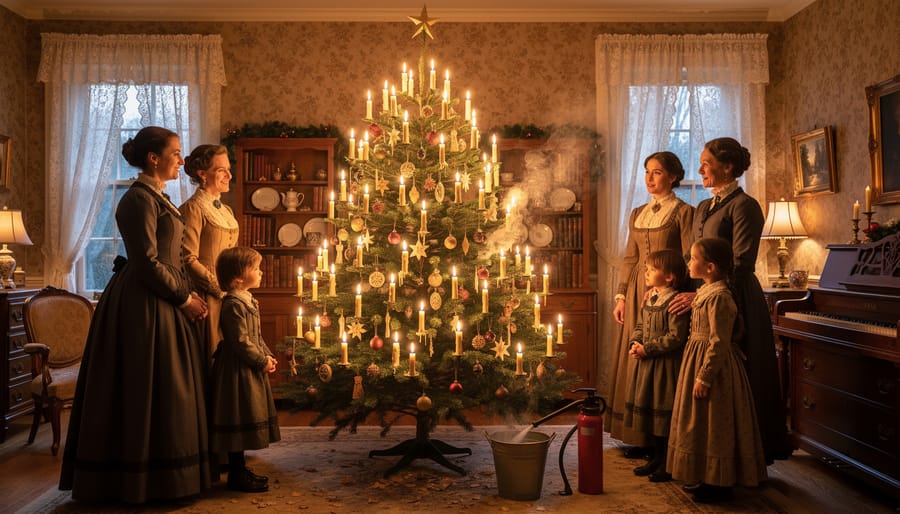
Picture a cozy parlor in 1850s Germany, where families gathered around their evergreen tree on Christmas Eve, their faces illuminated by the gentle flicker of real candles. These tiny flames, clipped carefully to branches with special holders, cast dancing shadows across tinsel and handmade ornaments, creating a magical atmosphere that seemed to capture the very spirit of the season. The tradition of candlelit Christmas trees, or “Weihnachtsbaum,” was a breathtaking sight that spoke to the heart of holiday wonder.
Yet beneath this enchanting scene lurked a sobering reality. Those beautiful candles were also potential disasters waiting to happen. Families stationed buckets of water and sand nearby, and many never left their trees unattended while lit. The candles burned for perhaps fifteen to twenty minutes before being carefully extinguished, making the illumination a rare and precious event. Some households only lit their trees on Christmas Eve itself, transforming the moment into something truly sacred and special.
German immigrants brought this cherished but dangerous tradition across the Atlantic to America in the 1800s, where it gradually gained popularity among those willing to brave the risk. Fathers would carefully inspect branches for stability, mothers kept watchful eyes on curious children, and everyone understood that holiday magic required constant vigilance. Fire departments reported countless blazes each December, with dried-out trees becoming tinderboxes that could engulf entire rooms in minutes.
The beauty was undeniable, but families yearned for something safer. They wanted to extend that golden glow beyond just a few precious moments, to create lasting memories without the heart-stopping fear. Little did they know that innovation was already sparking on the horizon.
The Spark of Genius: Edward H. Johnson’s Illuminating Idea
A Display Worth Talking About
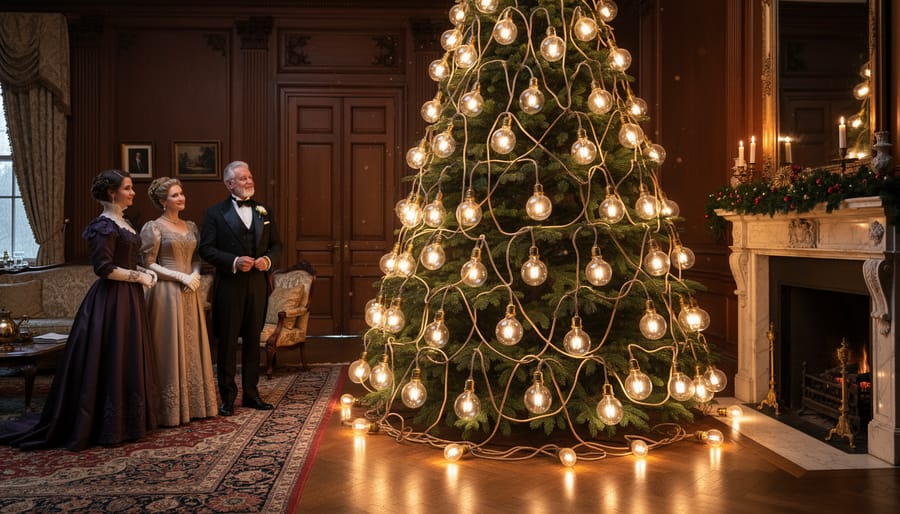
Picture this enchanting scene: On a chilly December evening in 1882, passersby along Fifth Avenue in New York City stopped dead in their tracks. There, glowing through the windows of Edward Johnson’s home, were eighty hand-wired electric bulbs—red, white, and blue—twinkling merrily on a rotating evergreen tree. Imagine the gasps of wonder, the children pressing their noses against the cold glass, their breath fogging up as they tried to catch every magical flicker.
The New York Times couldn’t resist covering this spectacular sight, describing it as a dazzling marvel that seemed to belong more to the realm of fairy tales than reality. Their reporter noted how the lights “twinkled and sparkled” as the tree slowly turned, creating an almost hypnotic dance of color. Word spread like wildfire through the city’s social circles. Neighbors gathered outside Johnson’s window each evening, creating impromptu celebrations on the sidewalk. For the first time in history, Christmas lights weren’t just about illumination—they were about pure, childlike wonder and the promise of a brighter, more magical holiday season ahead.
Why It Took Decades to Catch On
While the twinkling magic of electric Christmas lights captured imaginations from that first glowing display in 1882, it would take nearly half a century before families everywhere could welcome this wonder into their own homes. The journey from exclusive novelty to cherished tradition was paved with considerable obstacles that kept the sparkle out of reach for everyday folks.
The most daunting barrier was the extraordinary expense. A single string of hand-wired electric bulbs could cost the equivalent of several weeks’ wages for an average worker, making them a luxury reserved only for the wealthy elite. The Coolidge and Adams families who could afford such extravagance were showcasing not just holiday spirit, but their prosperity.
Even more challenging was the simple fact that most American homes lacked electricity altogether. Through the 1920s, countless families still relied on gas lamps and candles for light. Without electrical wiring running through their walls, electric Christmas lights remained as distant as a fairy tale, no matter how much wonder they inspired.
Adding to these challenges was the need for specialized installation. These early lights required an electrician’s expertise to set up safely, adding another layer of cost and complexity. The process wasn’t as simple as plugging in a strand, it demanded professional knowledge and careful handling.
These formidable obstacles meant that for decades, most families continued their candlelit traditions, gazing through shop windows at the electric displays that symbolized a brighter, more modern Christmas just beyond their reach.
From Luxury to Living Room: Making Magic Affordable
The EVER-READY Company’s Game Changer
The dawn of the twentieth century brought a glimmer of hope for families dreaming of illuminated Christmas trees. The EVER-READY Company recognized that while Edison’s vision had sparked something magical, the complicated process of assembling individual bulbs and wiring kept electric lights firmly in the hands of the wealthy. In the early 1900s, they introduced a revolutionary concept: pre-assembled light strings that arrived ready to hang.
Picture the excitement of opening a box containing lights already strung together, eliminating the need for electrical expertise or tedious assembly. No more puzzling over wires or worrying about connections. These ready-made strings transformed what had been an overwhelming project into something approachable, though the price tag still made many families pause and dream. A single string could cost the equivalent of a week’s wages for an average worker, making them a true luxury investment that rivaled even today’s professional installation services.
Yet this innovation planted seeds of possibility. Electric Christmas lights were no longer just for millionaires and industrialists. Middle-class families began saving throughout the year, hoping to bring this modern marvel into their holiday celebrations.
Albert Sadacca’s Brilliant Solution
In 1917, a devastating fire sparked by holiday candles transformed one family’s grief into a glowing gift for the world. Fifteen-year-old Albert Sadacca couldn’t forget the newspaper headlines about the tragic blaze that had taken precious lives during what should have been the most wonderful time of year. As he watched the flickering flames of candles on his own family’s Christmas tree, a brilliant idea began to illuminate in his young mind.
The Sadacca family ran a novelty lighting business in New York City, crafting decorative bulbs for everyday use. Albert proposed something revolutionary: why not create colorful, safe electric lights specifically for Christmas trees? His parents, immigrants who had built their business through hard work and innovation, saw the promise in their son’s vision. Together, they began producing strings of small, affordable colored bulbs that could bring the magic of Christmas into ordinary homes without the constant fear of fire.
At first, families hesitated to embrace this new tradition. The earliest versions featured plain white bulbs, which seemed too stark and cold compared to the warm, romantic glow of candlelight. But Albert persisted, experimenting with hand-painted bulbs in brilliant reds, greens, and golds that danced like jewels on evergreen branches. The transformation was enchanting.
By the 1920s, Albert and his brothers had founded the NOMA Electric Company, which would become the largest Christmas lighting company in the world. Their mission went beyond profit; they were making Christmas safer, brighter, and more accessible to families everywhere. What began as one teenager’s compassionate response to tragedy had blossomed into a beloved tradition that would sparkle in hearts and homes for generations to come.
The Golden Age: When America Fell in Love with Electric Lights
The years following World War II ushered in a magical era when twinkling electric Christmas lights transformed from wartime luxury back into an American household essential. As soldiers returned home and prosperity bloomed, families eagerly embraced the festive glow that had been dimmed during the war years. By the 1950s, stringing colorful bulbs across evergreen boughs became as much a part of Christmas tradition as decorating cookies and singing carols around the piano.
This golden age brought a dazzling array of innovations that would define holiday memories for generations. Bubble lights, invented in 1946, captivated children and adults alike with their mesmerizing liquid-filled tubes that bubbled and glowed like tiny lava lamps on the tree. Families gathered in darkened living rooms, watching the colored liquid dance upward in tubes of red, green, blue, and gold, creating an enchanting spectacle that seemed almost alive with Christmas spirit.
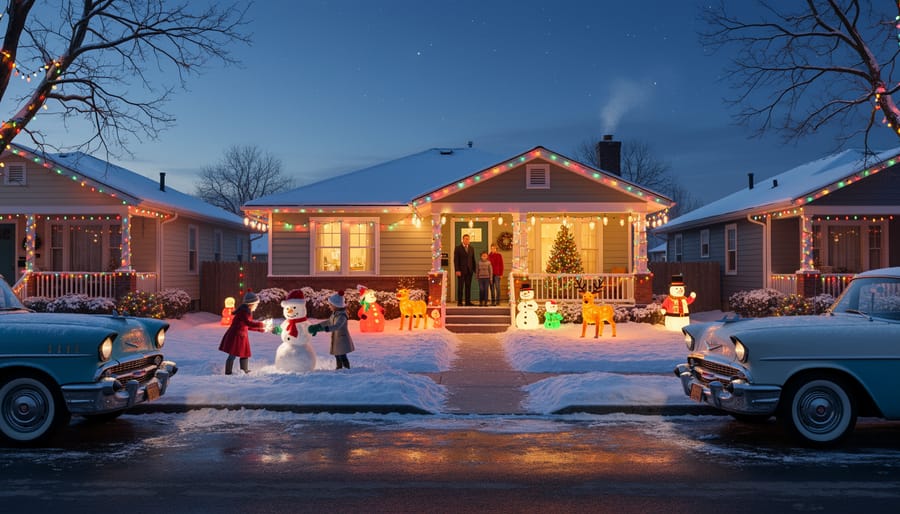
The post-war boom saw manufacturers introducing different types of Christmas lights in every imaginable shape and hue. C7 and C9 bulbs became household names, while miniature lights began appearing in stores, offering homeowners more delicate and intricate decorating possibilities. Outdoor displays grew more elaborate as neighborhoods engaged in friendly competitions, transforming entire streets into winter wonderlands that drew admirers from miles around.
Department stores showcased spectacular window displays featuring animated scenes illuminated by thousands of twinkling bulbs, inspiring families to recreate the magic at home. The ritual of testing each bulb, untangling strings from storage boxes, and carefully placing them on the tree became cherished traditions passed down through families, creating warm memories that still glow brightly in the hearts of those who remember when Christmas lights first turned ordinary homes into beacons of holiday joy.
How This Invention Changed Christmas Forever
The twinkling transformation that electric Christmas lights brought to our world extended far beyond their luminous glow. This brilliant invention didn’t just replace candles—it fundamentally changed how families celebrate together and created entirely new holiday traditions that warm our hearts to this day.
Before electric lights twinkled on trees, the flickering flames of candles posed constant danger to Victorian parlors. The shift to electricity meant making homes safer during the most wonderful time of the year, allowing parents to breathe easier as children gathered around the glowing tree. No longer did families need to keep vigilant watch over open flames or face the heartbreak of holiday fires that could destroy cherished memories in moments.
As the technology became affordable, the magic spilled beyond living room windows and onto rooftops, porches, and front yards. Suddenly, entire neighborhoods became enchanted winter wonderlands, transforming ordinary streets into corridors of celebration. The glow of colored bulbs against fresh snow created scenes straight from storybooks, inviting neighbors to stroll together through illuminated evenings, sharing hot cocoa and warm greetings.
This outdoor revolution sparked a beloved tradition that continues today—piling into the family car, thermoses of hot chocolate in hand, to tour neighborhoods aglow with creative displays. These twinkling journeys became treasured rituals, weaving communities together through shared wonder and friendly competition over who could create the most spectacular showcase.
Electric lights also deepened our understanding of why we put Christmas lights up—not just as decoration, but as beacons of hope, joy, and togetherness that pierce the darkest winter nights. They transformed Christmas from a single-day celebration into a season-long experience, illuminating our homes and hearts from Thanksgiving through New Year’s, creating countless magical moments that shimmer in our memories forever.
Tonight, as you string lights across your mantle or watch them twinkle on your tree, remember you’re part of a luminous story that began with one man’s bold vision more than a century ago. Edward Johnson’s simple act of lighting a tree in 1882 sparked a revolution that transformed our darkest nights into seasons of wonder. What started as an extravagant display for New York’s elite became the heartbeat of our holiday traditions, thanks to innovators who dared to make magic accessible to everyone.
These pioneers didn’t just invent a product; they gave us a language of light that speaks to something timeless in the human spirit—our desire to gather, to celebrate, to push back the winter darkness together. Today, when families untangle strands of lights and children press their noses against windows aglow with color, they’re honoring that same courageous spark of innovation. Each bulb carries forward a legacy of dreamers who believed that every home deserved its own constellation, that every family should experience the enchantment of a world illuminated by possibility and hope.