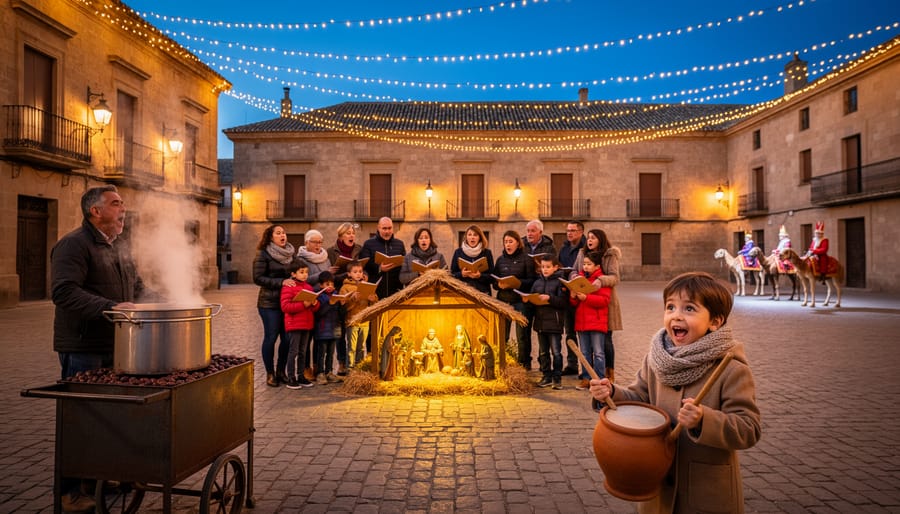
Imagine stepping into a Spanish plaza on a crisp December evening, where the air shimmers with the scent of roasted chestnuts and the sound of villancicos fills cobblestone streets. Spain transforms Christmas into a month-long celebration that stretches from early December through January 6th, weaving together centuries-old customs with regional flair that varies dramatically from Catalonia’s quirky Caga Tió to Andalusia’s elaborate nativity scenes.
Unlike many winter celebrations worldwide that peak on December 25th, Spanish Christmas follows its own enchanting rhythm. Children wait eagerly not for Santa Claus, but for the Three Wise Men who arrive bearing gifts on January 6th. Families gather around elaborate belenes—nativity scenes that transform entire rooms into miniature Bethlehem landscapes. The sound of zambombas, traditional friction drums, echoes through neighborhoods as communities sing together late into the night.
This is a country where lottery tickets become cherished Christmas gifts, where a traditional dinner might feature seafood rather than turkey, and where a hollow log literally poops out presents for delighted children. From the haunting beauty of midnight mass to the sweetness of turrón shared among loved ones, Spanish Christmas traditions offer a glimpse into a culture that savors every magical moment of the season. These customs, passed down through generations, reveal how Spain has crafted a holiday celebration that honors both sacred traditions and joyful family togetherness.
The Christmas Season Starts Later (But Lasts So Much Longer)
While many countries launch into full Christmas mode the moment November ends, Spain takes a wonderfully different approach. The Spanish Christmas season officially begins on December 8th with the Feast of the Immaculate Conception, a public holiday that marks the moment when homes begin their festive transformations. Rather than rushing headlong into holiday frenzy, Spanish families ease into the celebration with a gentle, anticipatory rhythm that feels almost like a secret the rest of the world has yet to discover.
Picture this: as December 8th arrives, families gather to unpack their beloved Belén, the intricate nativity scenes that become the centerpiece of Spanish Christmas décor. Unlike the quick setup and teardown familiar elsewhere, these displays are lovingly assembled piece by piece, often growing more elaborate as the days progress. Windows begin glowing with twinkling lights, and the scent of cinnamon and orange peel starts drifting through neighborhoods, but there’s no rush. Christmas in Spain is a marathon of joy, not a sprint.
The beauty of this extended timeline means the magic doesn’t peak and fade quickly. Instead, it builds like a slow-crescendo symphony, swelling through Christmas Eve’s Nochebuena feast, cresting on Christmas Day, and continuing to rise through New Year’s Eve and beyond. The season doesn’t conclude until January 6th, Three Kings Day, when children finally receive their gifts and the last pieces of traditional roscón de reyes are savored.
This unhurried approach to Christmas creates something precious: nearly a full month where families can truly savor each tradition, each gathering, each twinkling light against the winter darkness. The Spanish have mastered the art of making Christmas last, proving that sometimes the best gifts come to those who wait.
Belenes: The Nativity Scenes That Steal the Show
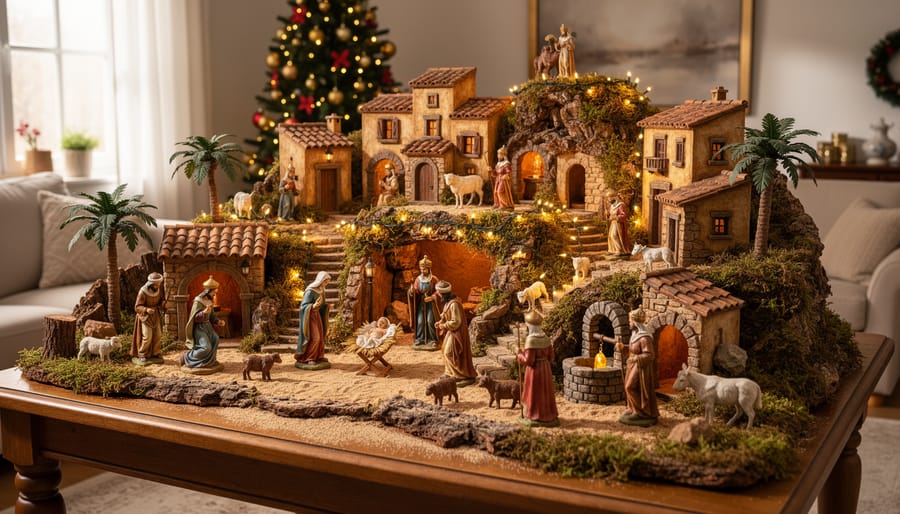
In Spanish homes, something magical happens each December as families gather around dining room tables and living room floors, carefully unwrapping treasured figurines that have passed through generations. The belénes, Spain’s cherished nativity scenes, transform ordinary spaces into miniature worlds where the story of Christmas comes alive in breathtaking detail.
Unlike the simple manger displays found in many countries, Spanish belenes are elaborate landscapes brimming with personality and imagination. These aren’t just religious displays—they’re artistic masterpieces that might feature cascading waterfalls made from aluminum foil, villages with tiny lit windows, moss-covered hills dotted with shepherds and their flocks, and winding paths leading travelers toward the glowing stable. Many families spend entire weekends constructing these scenes, with children eagerly placing each sheep, villager, and angel while grandparents share stories about which figurines came from their own childhood belenes.
The artistry extends beyond individual homes. Churches and town squares across Spain host spectacular public belenes that draw crowds year after year. Barcelona’s famous living nativity scene features real people and animals recreating the journey to Bethlehem, while Madrid’s Plaza Mayor becomes home to the beloved Belén market, where vendors have sold handcrafted figurines for over a century. In Catalonia, you’ll discover the quirky tradition of the caganer—a cheeky little figure hidden somewhere in the scene that adds humor to the sacred story.
Regional variations make each belénes unique. Andalusian versions might showcase white-washed villages reminiscent of their hillside pueblos, while Galician scenes incorporate local stone and Celtic influences. Some families add new pieces each year, turning their belénes into evolving family chronicles where a tiny ceramic baker or fisherman becomes a memory marker of Christmases past.
The ritual of unpacking, arranging, and finally placing baby Jesus in the manger on Christmas Eve connects Spanish families to centuries of tradition, transforming December into a season of creativity, togetherness, and wonder.
Nochebuena: Christmas Eve’s Midnight Magic
As the December sun sets on Christmas Eve, something magical stirs in Spanish homes. Nochebuena is when the heart of Spanish Christmas truly begins to beat, and unlike many countries where celebrations wind down by bedtime, Spain’s most treasured holiday moments are just awakening.
The evening starts quietly, with families gathering as twilight paints the sky in shades of purple and gold. But patience is essential here, for the grand feast won’t grace the table until remarkably late by many standards. Around ten or eleven at night, sometimes even midnight, families finally sit down together for what many Spaniards consider the most important meal of the year.
The table groans under the weight of tradition and abundance. Platters of succulent roasted lamb or tender cochinillo, the famous suckling pig with its crackling golden skin, take center stage. Seafood lovers feast on prawns the size of small lobsters, sweet langostinos, and delicate merluza. The air fills with the aroma of simmering consommé, rich with the flavors of generations past. Polvorones and turrón await dessert time, their sweet almond fragrance mingling with the scent of candlelight and pine.
What makes Nochebuena truly special isn’t just the food, though it’s spectacular. It’s the warmth of three, sometimes four generations gathered around one table, sharing stories that bridge decades, laughter that echoes through ancient family homes, and love that transcends the simple act of breaking bread together.
As the feast winds down in the early morning hours, many families bundle up and make their way to La Misa del Gallo, the Midnight Mass, named for the rooster’s crow that supposedly heralded Christ’s birth. Churches glow with candlelight as communities unite in song and prayer, welcoming Christmas morning together in a moment of profound beauty and shared faith that transforms the entire night into something unforgettable.
The True Stars: Los Reyes Magos and Three Kings Day
While children in many countries eagerly await Santa’s visit on Christmas Eve, Spanish children know that the real magic happens nearly two weeks later. In Spain, the Three Wise Men—Los Reyes Magos—are the true stars of the gift-giving season, arriving on the night of January 5th to deliver presents to children who’ve been good throughout the year. This cherished tradition holds a special place in Spanish hearts, often eclipsing December 25th in importance and wonder.
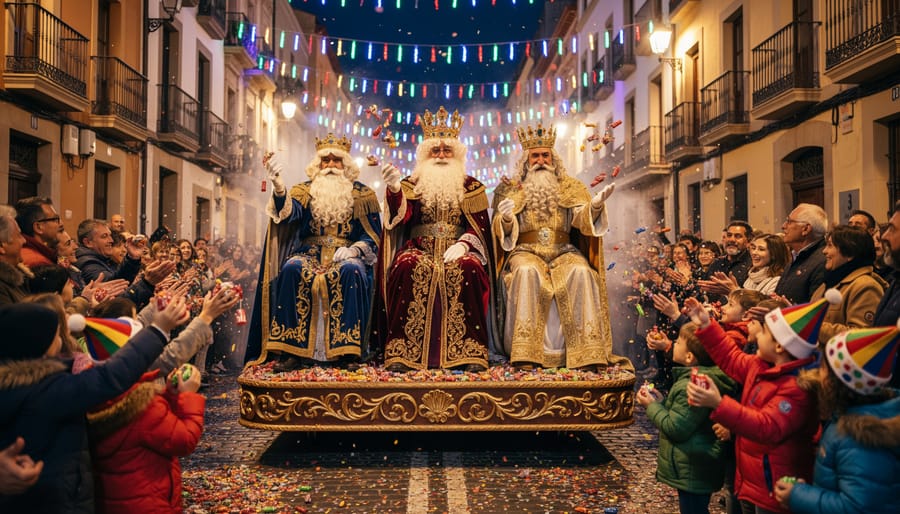
The excitement builds on the evening of January 5th, when communities across Spain come alive with spectacular Cabalgata de Reyes parades. Picture the streets illuminated with twinkling lights as elaborate floats carry the three majestic kings—Melchior, Gaspar, and Balthazar—dressed in flowing robes and golden crowns. Their camels sway gracefully through the crowds while attendants toss sweets and small toys to delighted children lining the streets. The air fills with music, laughter, and the sweet scent of candy as families bundle up in warm coats to witness this magical procession. These parades transform ordinary Spanish towns into enchanted kingdoms, creating memories that children carry into adulthood.
Before bed on this enchanting night, children polish their shoes until they gleam and leave them on balconies, windowsills, or by the front door, sometimes alongside carrots or water for the kings’ tired camels. Just as children in other countries enjoy writing to Santa, Spanish youngsters pen letters to the Three Kings expressing their wishes and promises to behave well. The anticipation is deliciously unbearable as they drift off to sleep, dreaming of the treasures awaiting them.
January 6th dawns with squeals of joy as children discover their shoes surrounded by beautifully wrapped gifts. Families then gather to share Roscón de Reyes, a ring-shaped cake adorned with colorful candied fruits resembling jewels fit for royalty. Hidden inside are a small figurine and a dried bean—finding the figurine crowns you king or queen for the day, while the bean means you must buy next year’s cake. This sweet tradition perfectly captures the Spanish celebration: community-focused, steeped in symbolism, and utterly magical.
Sweet Traditions: Turrones, Polvorones, and Holiday Treats
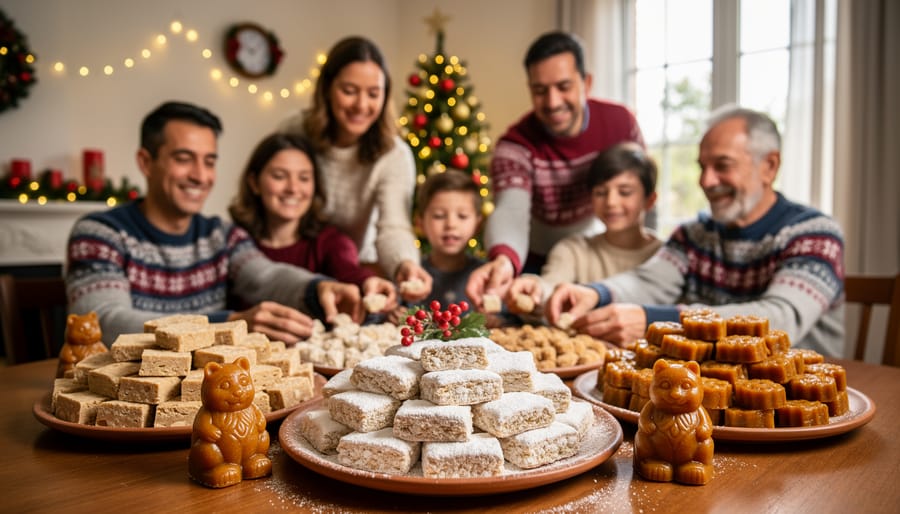
The moment you unwrap a golden bar of turrón, its honeyed almond scent fills the air like a sweet promise of Christmas joy. This beloved Spanish confection, made from honey, sugar, egg whites, and toasted almonds, arrives in shops as early as October, signaling that the magical season is drawing near. The two classic varieties tell their own delicious story: turrón de Alicante offers a satisfying crunch with whole almonds suspended in caramelized honey, while turrón de Jijona melts on your tongue with its smooth, marzipan-like texture.
Alongside turrón, the crumbly, powdery polvorones practically dissolve in your mouth, leaving a trail of cinnamon and almond that tastes like childhood memories. Wrapped in colorful tissue paper, these delicate shortbread cookies require a special unwrapping ritual, often shared between grandmothers and grandchildren in kitchens across Spain. The powdered sugar coating clings to fingertips and lips, creating moments of laughter and connection that embody the season’s warmth.
Every region adds its own sweet signature to the Christmas table. In Toledo, artisans craft intricate marzipan figurines shaped like fruits, animals, and nativity scenes, continuing traditions that date back to medieval convents. Catalonia celebrates with neules, delicate rolled wafers, while Galicia offers filloas, thin crepes drizzled with honey.
These holiday baking traditions transform Spanish homes into fragrant havens throughout December and January. Families gather around tables laden with wooden boxes of assorted sweets, passing them from hand to hand, savoring each bite alongside steaming cups of hot chocolate or sweet wine. The act of sharing these treats becomes a language of love, weaving together generations through flavors that remain unchanged across centuries.
El Gordo and New Year’s Eve: Luck, Grapes, and Good Fortune
Before the Christmas festivities reach their peak, Spain pauses for one of the most anticipated events of the season: El Gordo de Navidad, the world’s largest lottery drawing held on December 22nd. The name translates to “The Fat One,” and it certainly lives up to its reputation, distributing over two billion euros in prizes across the nation. What makes this tradition truly magical isn’t just the money, but the way it weaves communities together in hopeful anticipation.
Picture families gathering around their televisions and radios, listening as children from the San Ildefonso school in Madrid sing out the winning numbers in their distinctive, centuries-old melodic chant. The tradition dates back to 1812, and that haunting melody has become the sound of hope itself. Towns often pool their resources to buy lottery tickets together, meaning that when a winning number hits a small village, entire communities celebrate as one. Shop owners, neighbors, and strangers become instant companions in fortune, sharing tears of joy and champagne toasts that echo through cobblestone streets.
As Christmas gives way to New Year’s Eve, or Nochevieja, another delightfully quirky tradition takes center stage: the eating of twelve grapes at midnight. As the clock tower’s bells chime twelve times to welcome the new year, Spaniards across the country attempt to eat one grape with each toll, each representing good luck for the twelve months ahead. It’s harder than it sounds, and the challenge brings laughter and sticky fingers to living rooms and public squares alike.
Families gather in Madrid’s Puerta del Sol or watch the broadcast from home, grapes at the ready, creating a moment of shared anticipation and joyful chaos that unites the entire nation in hopeful sweetness.
Regional Celebrations That Add Extra Sparkle
Spain’s Christmas magic multiplies across its diverse regions, each adding its own enchanting twist to the holiday season. Just as European Christmas traditions vary beautifully from country to country, Spain’s provinces celebrate with delightfully distinct customs.
In Catalonia, children gather around the Caga Tió, a charming log with a painted face and festive red cap. Families feed this magical log treats throughout December, then on Christmas Eve, youngsters sing special songs while beating it with sticks, encouraging it to “poop” out presents hidden beneath a blanket. This whimsical tradition brings giggles and joy to Catalan households each year.
The Basque Country welcomes Olentzero, a jolly charcoal maker who descends from the mountains on Christmas Eve bearing gifts. This beloved figure, often depicted with a pipe and traditional beret, represents the region’s unique cultural heritage and predates the arrival of the Three Kings tradition.
Down in sun-soaked Andalusia, the air fills with passionate villancicos, traditional Christmas carols sung with flamenco-inspired rhythms. Families gather around guitars and zambombas, creating music that’s distinctly southern Spanish. Similar to how Sweden celebrates Christmas with its own regional flavors, these Andalusian melodies capture the warmth and spirit of Mediterranean Christmas celebrations, turning every gathering into a spirited fiesta of faith and family.
As the last echo of villancicos fades and the final roscon de reyes crumb is savored, the magic of Spanish Christmas lingers like the sweet scent of turrón in the air. These traditions remind us that while the holiday spirit speaks a universal language of love and togetherness, each culture adds its own beautiful accent to the celebration. From the anticipation-filled days of Advent through the grand finale of Three Kings Day, Spain’s extended Christmas season teaches us something precious: that joy need not be rushed, and celebration deserves to be savored.
The Spanish approach to Christmas, with its emphasis on family gatherings, shared meals, and time-honored rituals, offers a refreshing perspective in our often hurried world. Whether it’s the whimsy of Caga Tió bringing laughter to Catalan homes, the solemnity of midnight Mass on Nochebuena, or the wonder of children leaving shoes out for the Three Kings, these customs create moments that live forever in the heart.
This holiday season, consider weaving a thread of Spanish tradition into your own celebrations. Perhaps extend your festivities until January sixth, indulge in an extra special seafood feast on Christmas Eve, or gather around to sing carols with tambourines and guitars. By embracing these Mediterranean-inspired customs, you’ll discover that the true magic of Christmas lies not just in the traditions themselves, but in the warmth, connection, and joy they bring to those we hold dear.